General information
UAB “Buiteka LT” NVB/AF batch-operated biological wastewater treatment systems are designed for the treatment of household wastewater and wastewater with similar chemical composition, in accordance with the currently valid wastewater treatment standards specified in the “Wastewater Management Regulation,” approved by the Minister of Environment by Order No. D1-236 on 17 May 2006 (2019 edition).
Characteristics of the proposed equipment:
- The equipment is environmentally friendly, as the aerobic microorganisms within it biologically break down wastewater pollutants, emit no unpleasant odors, and the treated wastewater is harmless and odorless
- The equipment operates quietly, as it has no moving parts
- Made from fiberglass, all the main external and internal structural elements are durable and resistant to corrosion
- The system consists of a single tank, so no additional primary treatment or supplementary treatment equipment is required
- The aeration method is through the use of an air blower
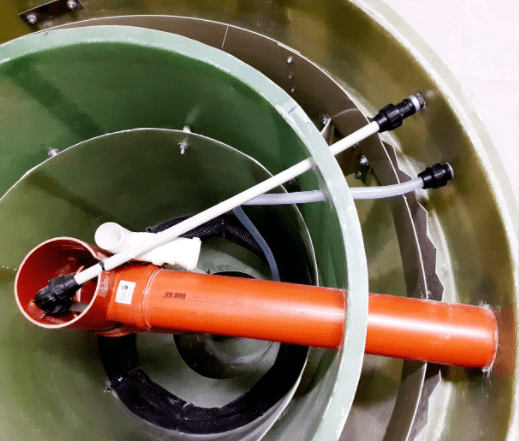
Operating principle and construction
The wastewater treatment principle is biochemical oxidation by activated sludge under aerobic conditions. The aeration tank and the secondary settling tank with all their characteristic elements are mounted in a single round cone-shaped tank. Activated sludge recirculation is self-acting (the sludge slides from the secondary settling tank into the aeration section down the slope of the conical bottom (the angle with the horizon is about 50°). Air blowers and aerators of the required pressure and capacity are used for aeration.

*The volume of treated wastewater is indicated when its contamination, according to BOD5, is 260-360 mg O₂/l


NVB/AF 1 - Hatch; 2 - Upper part of the casing; 3 - Lower part of the casing; 4 - Aeration chamber; 5 - Inflow pipe; 6 - Air supply pipe; 7 - Diffuser; 8 - Filler; 9 - Secondary clarifier; 10 - Circulating sludge pipe (airlift); 11 - Treated wastewater outlet pipe. (The pipe connection directions shown in the diagram are for reference and are finalized during the ordering process.)
Wastewater flows by gravity through the inlet pipe (5) into the aeration chamber (4) of the plant, where, during intensive aeration, it is mixed with activated sludge. Air supplied by the air blower is directed through the supply pipe to the lower part of the aeration chamber, where it rises upward in fine bubbles through the diffuser, saturating the mixture of wastewater being treated and activated sludge with oxygen. Biological wastewater treatment takes place in the aeration chamber: the microorganisms in the activated sludge break down organic pollutants into simpler chemical compounds – nitrites and nitrates, most of which are later oxidized to carbon dioxide and water.
The mixture of treated wastewater and activated sludge passes from the aeration chamber (4) over a horizontal overflow edge into the secondary settling tank (9). In the settling tank, the clarified treated wastewater flows over a serrated edge into an annular trough and exits the plant through the wastewater outlet pipe (11). The activated sludge in the mixture, acted upon by gravity, settles to the lower part of the settling tank and slides to the bottom of the aeration tank. From the bottom, the activated sludge is lifted by the air stream and mixed in the aeration chamber (4).
An airlift (10) is installed in the aeration chamber, which is switched on periodically, thus creating aeration, mixing and rest (idle) modes in the plant. During the aeration mode the airlift does not operate. The mixing mode is ensured by opening a valve.
During this process, the sludge is lifted from the bottom of the aeration chamber to the top of the aeration chamber, as a result of which nitrogen compounds are removed from the wastewater. Air bubbles rising to the surface of the secondary settling tank disturb the crust of floating sludge and the sludge settles to the bottom of the plant. During the rest (idle) mode the air blower is switched off, creating conditions for the release of carbon dioxide from the wastewater.
These modes are automatically controlled by a special controller installed in the air blower well. The controller has modes: guests – increased; holidays – reduced loading of the plant with wastewater.
The contamination of treated wastewater with biogenic substances (nitrogen and phosphorus compounds) in treatment plants with a capacity of up to 5.0 m³/day has been regulated since 2019-11-01 and must not exceed: NB < 25 mg/l and PB < 5.0 mg/l. Biogenic substances are successfully removed here by combining nitrification and denitrification processes in the plant, leaving as much of them as is needed for the cell synthesis of the activated sludge microorganisms and to maintain their vital activity.
The capacity of the plant is increased by concentrating the activated sludge using the “attached microflora” method, i.e. by placing an appropriate medium (8) in the aeration tank.
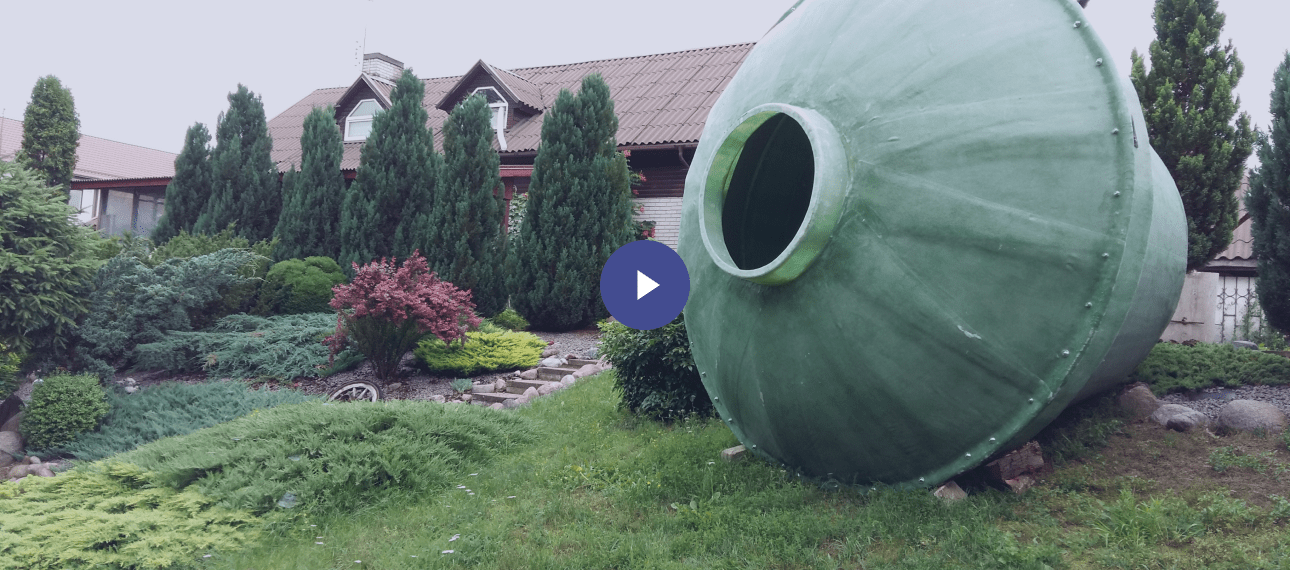

Wastewater treatment plant
controller
With this controller, the wastewater treatment plant can be controlled remotely.